
For many whisky lovers, peat is the heart of the flavour profile, offering an incomparable depth and complexity – and is what makes whisky a drinkable drop in the first place. Many beginners, however, can’t stand peated whiskies at all. In their opinion, it masks any nuances of flavour. In this article, you’ll discover what role peat plays in whisky and how and why it affects its aroma.
Almost a quarter of Scotland is covered in peat
Scotland is known for its harsh weather conditions and hard bedrock. The conditions are therefore ideal for the formation of peat. Over 1.8 million hectares of Scotland are covered in peat. This corresponds to approximately 23 per cent of the land area. On the island of Islay, it covers almost 70 per cent of the surface. It is therefore natural to use peat as an energy source and affordable fuel, as well as in the production of Scotch whisky . Accordingly, it plays a major role in its production.
How the organic soil layer is formed
Peat, or “peat” in English, is the light brown to black organic layer of soil that forms from the partial decomposition of plant material. In peatlands that are covered or saturated with water, plants decompose slowly and only partially, causing the plant matter to become depleted in hydrogen and oxygen while its carbon content increases, giving peat its characteristic colour. The chemical composition of peat is influenced by the type of vegetation and the degree of its decomposition.
Different peat bogs and different whisky flavours
The differences between peat bogs are enormous. Blanket bogs, fens, and transitional bogs represent different types of peat that differ in their composition and the conditions under which they are formed. Similar to wine, terroir also plays an important role in whisky and peat.
Scotland has a wide variety of peat types, each with its own character and aromas. On Islay and the other islands , there are different types of peat shaped by the local vegetation. For example, the peat bogs of the Orkneys mainly contain decomposed heather plants, while the peat on Islay is characterised by rotted heather, algae and seagrass, as well as salty notes, each of which affects the aroma and can also be found in the flavour of the whisky.
The extraction of peat for whisky production
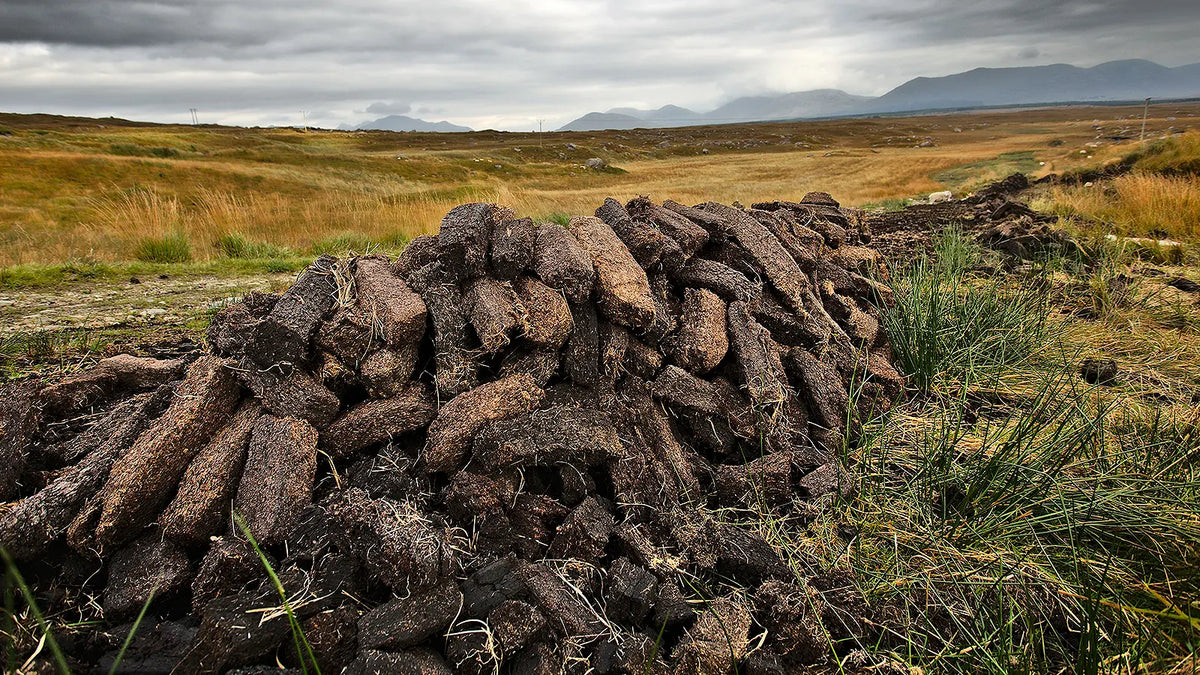
Scottish peat is traditionally cut by hand. This is known as “peat cutting” (or “peat cutting” in English). The surface vegetation of the peat bank is carefully removed and later used again to cover it. This is intended to preserve the peat bank. After cutting, the peat is also often cut into manageable pieces and transported to the distillery.

Peat in malting and drying the barley for whisky
The use of peat begins with malting the barley. Here, the barley is first soaked and then allowed to germinate. The germination process converts the starch in the barley into sugar, which is essential for the later production of whisky during fermentation. The actual influence of peat comes into play when stopping the germination of the barley that comes from “floor malting”. This is done by drying the barley in a “kiln”, which is simply a large oven. The barley is spread out on top, while the peat burns underneath. The rising peat smoke dries the barley and makes it suitable for storage.

Drying the barley over a peat fire is crucial for creating the peaty flavour profile preferred by many whisky lovers. The smoke particles from the burning peat adhere to the barley and thus contribute to its flavour. The duration of the drying and the intensity of the fire are decisive for the strength and type of smoke aroma. Consequently, every distillery has its own methods and traditions when it comes to using peat. However, the type of peat and its origin also affect the aroma of the whisky.
Measuring the peat content of whisky and the importance of “ppm”
By the way, the peatiness of a whisky is often measured in ppm and sometimes also stated. This stands for “parts per million” and indicates the content of phenolic compounds in the whisky. They are responsible for the smoky aroma. Whiskies with a high ppm value are therefore more smoky and peaty. The ppm values can range from a few ppm in lightly peated whiskies to over 50 ppm in extremely peated varieties.
Responsibility for the sustainable extraction of peat

Cutting peat for whisky is a sensitive intervention in delicate ecosystems
In recent years, the sustainable use of peat in the production of Scotch whisky has increasingly come into focus. Distilleries are increasingly adopting sustainable practices in peat extraction and exploring alternatives to reduce their ecological footprint. This is because peat bogs are not only important for whisky production. They also play an important role in the global carbon cycle as delicate ecosystems
Buy peaty and smoky whiskies at CaptainScotch.de
In our shop you will find a large selection of peated and smoky whiskies, such as many representatives from the island of Islay. Well-known representatives of smoky Scotch whiskies are above all Ardbeg, Bruichladdich, Caol Ila and Kilchoman.